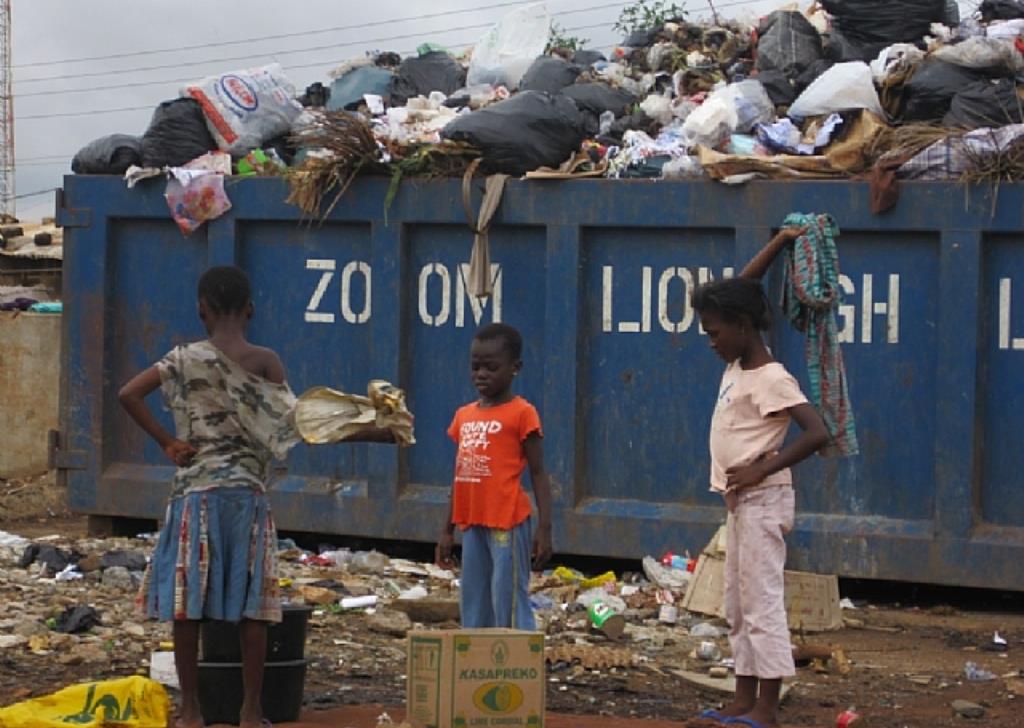
POOR SANITATION/FILTH IN GHANA

Featured

There have been numerous definitions about filth, yet it simply means anything considered extremely dirty or disgusting.  This is how a country with two special attributes; ‘THE GIANT OF AFRICA’ and ‘THE GATEWAY TO AFRICA‟ has been described across the world. From a report submitted by the World Health Organization (WHO), Ghana was ranked the 7th dirtiest country in the world.  Ghana is still battling this problem of dirt along our streets, market places and in our communities despite the various interventions by the Environmental Protection Agency(EPA).I suppose it is time we uncover the covered truth regarding the causes of filth in Ghana because a country’s able and energetic labor force is greatly influenced by good sanitation.

First and foremost, lack of knowledge concerning waste management. Majority of the Ghanaian citizen have no or less knowledge concerning the appropriate means of waste disposition. In Ghana, during rainfall, Ghanaians see this as a great opportunity for them to dispose their waste. They do this by throwing their huge heavy waste into the running water, expecting it to be carried away to another destination forgetting it can get choked along the way. Continuous execution of this practice will gradually lead to development of heap of rubbish at where they get choked. In the long run, insects like mosquitoes, tsetse flies, houseflies among other begin to breed there. Some Ghanaians are also found of throwing their waste over fences to their next neighbors with the mindset that they are properly disposing the filth they made themselves. On the contrary, it is a clear evidence of lack of knowledge. This is what the Holy Book explains as ‘my people are destroyed for lack of knowledge…….'(Hosea 4:6). These practices are commonly undertaken by residents of at Ashaiman, Chorkor, Bukom, James town, Circle and Nima.

Again, our government can also be blamed for poor sanitation in the country. On the 6th of March 1957 since Ghana gained her independence from her colonial masters, several elections has been held to enable the eligible and qualified electorate to exercise their franchise as provided to them in the 1992 constitution of Ghana. Through the conduction of these elections, Ghana has been able to maintain a peaceful change of government. These governments have failed in executing the policies promised in their manifestoes concerning sanitation. In page nineteen (19) of the New Patriotic Party’s (NPP) 2000 manifesto, under policies for selected areas of the economy, they stated clearly that, ‘there will be development of roads, drainage and culverts to improve accessibility, mobility and sanitation and to reduce incidence of floods to the minimum’. Again, at same page the NPP said ‘they are aware of the annual flooding of large parts of the Northern and Upper Regions as a result of the opening of spillways of dams in Burkina Faso, especially during the rainy season’. ‘The NPP government shall embark on a very comprehensive program to provide structures to protect these regions’. In June 28, 2001 a year after the manifesto was the read, Accra witnessed the worst flood that has ever occurred since July 4, 1995. This unprecedented flood submerged portions of the city, including houses and structures at Madina, Achimota, Dzorwulu, Averno, Santa Maria and Adabraka official town being affected. Another incident that occurred under the reign of the NPP government was in June 2007. In June 2007, floods hit the Upper West, Upper East and Northern Regions. Three hundred and seven thousand, one hundred and twenty-seven people were affected.

Similar accident which occurred as a result of the reigning government not executing what they state in their manifesto concerning sanitation was under the reign of National Democratic Congress (NDC). With respect to sanitation, the NDC government said ‘they will put the provision of sanitation facilities at the core of Government’s social  policies and programs over the next four years with key policy initiatives, including the establishment of a National Sanitation Authority(NSA) as an autonomous agency under the Local Government Service to coordinated a harmonized sanitation policy and program, for implement by the Metropolitan, Municipal and District Assemblies(MMDA’S) and private sector operators’.

The NDC also pledged to implement the ‘sanitation for All Ghana Compact(AGC)’ and have it managed sustainably by the new NSA as a special body under the Local Government Authority with independent source of funding and a strong enforcement to mandate on issues of sanitation and waste management. These policies never became a reality till date meanwhile they won the 2012 election. This explains how our government has contributed poorly to sanitation in Ghana.

Ghana may have been described as the 7th dirtiest country in the world; conversely Ghana can be ranked as 7th cleanest and finest country in the world provided we are ready to fight filth together as a nation. Education of the citizens on the appropriate means of waste disposition is the first step towards filth fighting. In our world where there is easy access to various social media networks, television, radio, newspaper, libraries and textbooks, education of citizens on sanitation can be done through the use of these means. This education must be based on the immediate effects of inappropriate waste disposition. For instance, enlightening citizens on the primary cause of the unforgettable accident that occurred on June 3 will persuade them put a stop to improper disposition of filth.

They must be cautioned using the media that numerous deadly and infectious diseases like cholera, malaria and diarrhea break out easily at place where they are heap of rubbish. By educating them on all this, they will learn to keep their environment clean at all times. Enactment of sanitation laws by the government can aid in the journey to getting rid of filth in Ghana. The government must pass laws purposely to check sanitation in the country. This law must contain punishment available to people caught loitering the environment haphazardly. Court finds and purchase of some amount of refuse dumb containers by persons found guilty are some of the punishment that can be included in the sanitation law. Also, in other not create a room for excuses by people found guilty; the government must invest in the sanitation sector. In corporation with the various sanitation agencies in Ghana, refuse bin must be made available at many places across the country especially where there is huge crowd congestion. This activity will gradually eliminate heaps of rubbish along our streets, market centers, schools and in our homes. 

Finally, sanitation must be seen as the duty of all. The issue of sanitation should not be seen as the duty of the reigning political party or the government sanitation agencies only. Sanitation must be seen us the duty and responsibility of every individual in the country. The break out of infectious diseases and disastrous floods knows no President or any innocent person in the country. This is why Political Parties craving for power to manage the affairs of the country shouldn’t see sanitation as a political tool used to win the vote of the electorates and the electorates shouldn’t also see sanitation as the duty of the government but the duty of us all. The world’s famous Narendra Modi once said ‘sanitation should not be seen as a political tool, but only be connected to patriotism and commitment to public health’.

To draw down the curtain, it is a disgrace that the GIANT OF AFRICA is categorized amongst the filthiest countries in the world. Notwithstanding this fact, I strongly believe Ghana can still make a change. We can only change from filthiest  to cleanest if we see sanitation as a duty of all, punish culprits who are caught loitering the environment and most importantly educating citizens on the negative things that occur as a result of inappropriate waste disposition. We must note that sanitation is as important as anything else done in the country. Let us all rise to fight the poor sanitation in our country for it to became a better place for as all to live and help change Ghana’s sanitation status across the world.

STAFF OF INFO WORLD

David Osei Agyemang
http://doagyemang.wordpress.com

DCS 19038

Esther Amenuku Makafui

http://greenthoughtspress.wordpress.com

DCS 19055

Comfort Badu Yeboah
http://comfortbadu.wordpress.com

DCS 19103                                     


Nortey Henrietta
http://galcansite.wordpress.com

DCS 19345


Atsu Joyce Afia Kafui        
http://ajay.art.blog         

                   DCS 19039          

Zinabu Adakurugu
http://azee5.wordpress.com

DCS 19289

Arthur Lynda Boatemah Zoe

http://misslynnzoe.wordpress.com

   DCS 19072

Zainabu Abdullahi Jumai

http://zainabasdotblog.wordpress.com

DCS 19089

Zulaiyat  Ahmed
http://gracedworldcom.WordPress.com

DCS 19297             

Bonuedi Patricia

http://thetriciasnews.wordpress.com

DCS 19116

KNOWING A CELEBRITY

Becoming a celebrity has become very easy in recent times as compared to the olden days where it takes a lot of hard work and achievements for one to be called a celebrity. For one to be called a celebrity of late depends on the person’s common abilities and mistakes.

In Ghana now, a lot of people are tagged with being a celebrity based on their profession, attitude, fashion sense, physical appearance and activities on social media platforms. Becoming a celebrity has become an ordinary goal for the youth today and here are some of the things they focus on to achieve that popularity.

PROFESSION

Celebrity by Profession

The profession of one now makes him a celebrity. Professions like journalism, acting, music etc. makes one popular due to the frequent exposure of the person’s image on TV and social media platforms. These professions make one to be seen as celebrity. In Ghana here we have people like Serwaa Amihere who gain popularity because of her profession as a journalist and other news presenters who are recognized as celebrities. Still on the area of profession, the skill of entrepreneurship is turning people into celebrities. Some personalities in Africa have gain popularity not because of fashion or any other thing that ordinarily makes one a celebrity but because of their entrepreneurial skills. 

One may ask why entrepreneurs are also recognized as celebrities. Some entrepreneurs have contributed immensely to social development and due to that, they gained popularity.  Entrepreneurship involves a lot of risk therefore when one succeeds he becomes an impact. There a lot of popular people who gained popularity due to entrepreneurship for example Aliko Dangote( a Nigerian) and Mr. Kwame Owusu Despite ( a Ghanaian); these two are well recognized when it comes west Africa.

FASHION

While others strive hard to impact in social development others also choose fashion. Recently fashion has become one of the most common ways of being addressed as a celebrity. Fashion is a popular style, especially in clothing, footwear, lifestyle, accessories, make up; hairstyle etc. fashion is a distinctive and often constant trend in the style in which people present themselves. This is the path most youth have chosen to gain popularity; it is one of the simple ways they say.

PHYSICAL APPEARANCE

Celebrity by Physique

For most ladies now, gaining more popularity is about their body. Most ladies now go through serious surgery just to get an all-curvy body. Some ladies believe that a little bit of cinching, smoothing in the tummy and hips can make them more refined and polished in clothes. Some also believe that having a curvy body is what makes them a woman; they therefore spend huge sums of money to get it. Some came with  a  curvy body naturally from birth. In Ghana now some ladies are trending as celebrities due to their curvy body shape.

The above are some few ways people adapt to become celebrities.

Meanwhile becoming a celebrity should be looked at from different dimension. A celebrity should be someone who impacts positively in society. There is a great need for calling someone a celebrity to be redefined. Most growing up kids look up to people who are tagged as celebrities and they end up trying to copy every single existence of the person. When people who have a negative image are also tagged as celebrities, it going to affect the development of a country.

It is about time we stand on our feet as a country to better redefine celebrities. Let’s start looking at an impactful celebrity not people who gain popularity by means of vulgar words.

GROWTH OF CORRUPTION IN AFRICA -GHANA

     It is not implausible to associate extreme poverty and perverse inequalities to countries with high levels of corruption. Corruption is one of the most destructive impediments to economic and social development. It takes away resources from the common pool and deprives large population of partaking in the share of the national cake. Despite Ghana’s good governance and democratic credentials, corruption still remains cancerous in our public service and society.   Currently, we can concretely say that corruption in Ghana is not just a mere perception but inherently pervasive in the country as evidenced by the recent exposé in the Ghana Football Association (GFA). Another exposé was in the judiciary. The judiciary is expected to adjudicate, preserve, safeguard and interpret laws that protect the citizenry. Hence corruption in the judiciary is serious and a big shame to the country at large. However if important members of the bench could be easily compromised then Ghana is in a serious quagmire. Below we shall consider some of the favors that has led to the increase rate of corruption in Ghana, the effects or consequences it has on the citizenry and solutions to help curb corruption in Ghana and Africa. To begin, lack of political will and leadership. Most African leaders since independence have hardly served their country’s interest. The continent is littered with countries whose leaders would have come to power with next to nothing to their names.

 Again, socio – cultural insensitivity. The Ghanaian society has grown increasingly insensitive to financial misappropriation of public officers .The entire continent seems to be in a struggle to maintain its moral center. While moral authority in Ghana and in most African countries have waned or collapsed entirely under the pressure of western values to wit materialism, globalization has successfully installed capitalist self -seeking motives where communal living and a community mindset is used to reign. The moral compass of Ghanaians and African societies have been so denatured  to the point where corruption is almost accepted as an inevitable cost of doing business.

More so, another cause of corruption in Ghana is the place of anti-corruption crusaders. The first notable anti-corruption crusader in the history of Ghana is Ft. Lout. Jerry John Rawlings (Ltd) whose coup d’états in 1979 and 1981 were fuelled by nationalist sentiments to rid the nation of oligarchs, influence peddlers, and corrupt political saboteurs. Much of his work is mired in controversy, especially the part that touches on the murder of the 3 judges and the retired army officer.

Lastly, corruption associated with the provision of common social services is more likely to affect poor people because they are more dependent on government or public facilities for the provision of essential services. Current research on the micro -level impact of corruption on Africa gives strong that poor people are likely to pay bribe than rich as they have limited options or alternatives for meeting their social needs.  Similarly, corruption stifles the growth of domestic business in the country as a result of the unofficial payments or bribes solicited from them by government mandated agencies.

This increases the cost of doing business in the country and makes Ghana uncompetitive globally for Foreign Direct Investment (FDI). Many businesses are expected to make unofficial payments to the very agencies that have been constitutionally mandated to monitor, promote and control their activities. Though corruption seems to be swallowing Ghana and Africa at large, recently there have been a lot more traction in the fight against corruption in Ghana. Organizations like the Ghana Anti -Corruption Coalition, Transparency International, Ghana Integrity Initiative, and IMANI are but a few of the civil society organizations fully engaged in activities to combat corruption in Ghana.  Thus, for now the effective way would be bottom up approach, where individuals like Anas Aremeyaw Anas, Manasseh Azure, Civil Society Organizations and the media must hold politicians accountable to the people by scrutinizing governments contracts even if our parliamentarians otherwise would not effectively play that role.

BRITISH AIRWAYS USES SOME U.K FACES FOR CAMPAIGN

             After 100 years of soaring the skies, British Airways is celebrating it centenary with a little help from some of Britain’s biggest household names and faces including Oscar winner, Olivia Coleman and Gary Old man and world boxing champion Anthony Joshua.

This Clever branding piece combines an array of high-profiles celebrities with emotive storytelling all designed to pull at the heart strings.

               Although the U.K finds itself in fairly uncertain political times, as Brexit negotiations drag on (for what feels like the 1485th years) the video still manages the stir and feeling of the youth.

  The policy was initially launched last May in the U.S to provide twitter users with clearer insight into political content and importantly, who is behind the advertisement of this and also involved the launch of Twitter’s Ads transparency center (ATC). Once the policy is rolled out only certified advertisers would be allowed to publish political campaigning ads. Which means going through a rigorous application process?

                   This will be welcome news for some countries and the European’s, who all have upcoming general elections in May that will not want to be tarnished with the same scandals that dogged both the US presidential elections and the Brexit referendum.

RELEASE LOAD SHEDDING TIMETABLE – Mutawakilu


The minority has raised concerns of the power outages recently over the week.
Ghanaians have been facing power outages that has hit the country due to some challenges
According to the Energy Minister, John Amewu, the power outages is as a result of some technical
changes they are facing..
The minority in Parliament Honourable Mutawakilu wants the government to release a load shedding
timetable to avoid unaware outages of power that is recently halting jobs of companies.
John Amewu, the Energy Minister have addressed the issue incinerating the power outages will be
resolved soon.
These problem of black out is as a results of Electricity Company of Ghana handing over to a private
company the Power Distribution Services which took effect on the 1st of March, 2019.
Many parts of the country has been hit with blackouts in the last couple of days.