
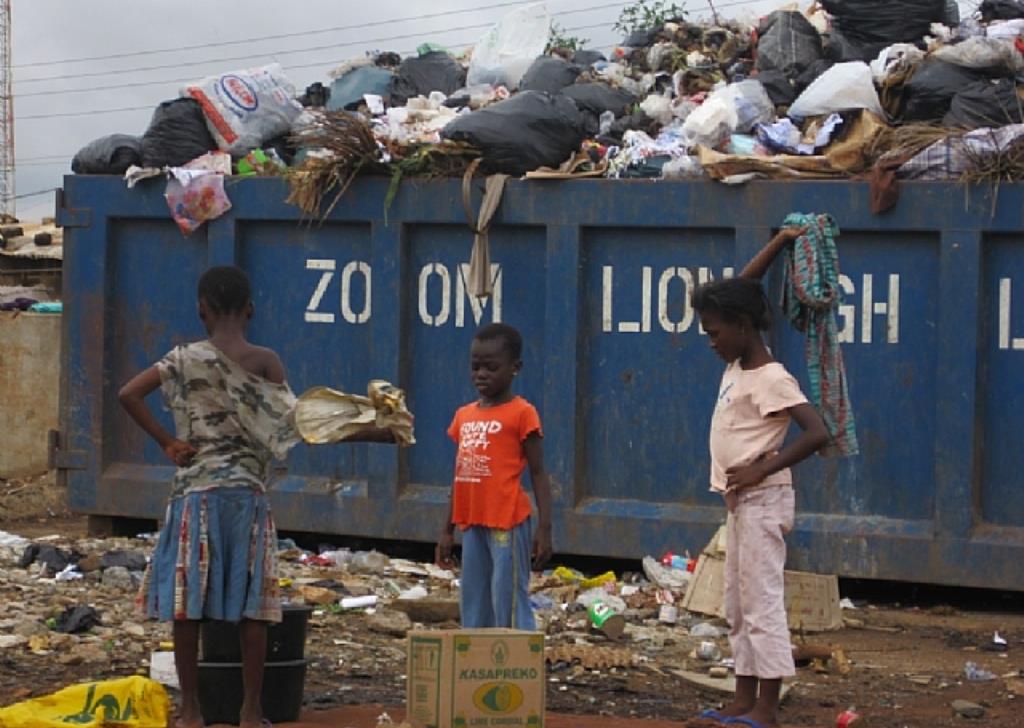
There have been numerous definitions about filth, yet it simply means anything considered extremely dirty or disgusting. This is how a country with two special attributes; ‘THE GIANT OF AFRICA’ and ‘THE GATEWAY TO AFRICA‟ has been described across the world. From a report submitted by the World Health Organization (WHO), Ghana was ranked the 7th dirtiest country in the world. Ghana is still battling this problem of dirt along our streets, market places and in our communities despite the various interventions by the Environmental Protection Agency(EPA).I suppose it is time we uncover the covered truth regarding the causes of filth in Ghana because a country’s able and energetic labor force is greatly influenced by good sanitation.
First and foremost, lack of knowledge concerning waste management. Majority of the Ghanaian citizen have no or less knowledge concerning the appropriate means of waste disposition. In Ghana, during rainfall, Ghanaians see this as a great opportunity for them to dispose their waste. They do this by throwing their huge heavy waste into the running water, expecting it to be carried away to another destination forgetting it can get choked along the way. Continuous execution of this practice will gradually lead to development of heap of rubbish at where they get choked. In the long run, insects like mosquitoes, tsetse flies, houseflies among other begin to breed there. Some Ghanaians are also found of throwing their waste over fences to their next neighbors with the mindset that they are properly disposing the filth they made themselves. On the contrary, it is a clear evidence of lack of knowledge. This is what the Holy Book explains as ‘my people are destroyed for lack of knowledge…….'(Hosea 4:6). These practices are commonly undertaken by residents of at Ashaiman, Chorkor, Bukom, James town, Circle and Nima.
Again, our government can also be blamed for poor sanitation in the country. On the 6th of March 1957 since Ghana gained her independence from her colonial masters, several elections has been held to enable the eligible and qualified electorate to exercise their franchise as provided to them in the 1992 constitution of Ghana. Through the conduction of these elections, Ghana has been able to maintain a peaceful change of government. These governments have failed in executing the policies promised in their manifestoes concerning sanitation. In page nineteen (19) of the New Patriotic Party’s (NPP) 2000 manifesto, under policies for selected areas of the economy, they stated clearly that, ‘there will be development of roads, drainage and culverts to improve accessibility, mobility and sanitation and to reduce incidence of floods to the minimum’. Again, at same page the NPP said ‘they are aware of the annual flooding of large parts of the Northern and Upper Regions as a result of the opening of spillways of dams in Burkina Faso, especially during the rainy season’. ‘The NPP government shall embark on a very comprehensive program to provide structures to protect these regions’. In June 28, 2001 a year after the manifesto was the read, Accra witnessed the worst flood that has ever occurred since July 4, 1995. This unprecedented flood submerged portions of the city, including houses and structures at Madina, Achimota, Dzorwulu, Averno, Santa Maria and Adabraka official town being affected. Another incident that occurred under the reign of the NPP government was in June 2007. In June 2007, floods hit the Upper West, Upper East and Northern Regions. Three hundred and seven thousand, one hundred and twenty-seven people were affected.
Similar accident which occurred as a result of the reigning government not executing what they state in their manifesto concerning sanitation was under the reign of National Democratic Congress (NDC). With respect to sanitation, the NDC government said ‘they will put the provision of sanitation facilities at the core of Government’s social policies and programs over the next four years with key policy initiatives, including the establishment of a National Sanitation Authority(NSA) as an autonomous agency under the Local Government Service to coordinated a harmonized sanitation policy and program, for implement by the Metropolitan, Municipal and District Assemblies(MMDA’S) and private sector operators’.
The NDC also pledged to implement the ‘sanitation for All Ghana Compact(AGC)’ and have it managed sustainably by the new NSA as a special body under the Local Government Authority with independent source of funding and a strong enforcement to mandate on issues of sanitation and waste management. These policies never became a reality till date meanwhile they won the 2012 election. This explains how our government has contributed poorly to sanitation in Ghana.
Ghana may have been described as the 7th dirtiest country in the world; conversely Ghana can be ranked as 7th cleanest and finest country in the world provided we are ready to fight filth together as a nation. Education of the citizens on the appropriate means of waste disposition is the first step towards filth fighting. In our world where there is easy access to various social media networks, television, radio, newspaper, libraries and textbooks, education of citizens on sanitation can be done through the use of these means. This education must be based on the immediate effects of inappropriate waste disposition. For instance, enlightening citizens on the primary cause of the unforgettable accident that occurred on June 3 will persuade them put a stop to improper disposition of filth.
They must be cautioned using the media that numerous deadly and infectious diseases like cholera, malaria and diarrhea break out easily at place where they are heap of rubbish. By educating them on all this, they will learn to keep their environment clean at all times. Enactment of sanitation laws by the government can aid in the journey to getting rid of filth in Ghana. The government must pass laws purposely to check sanitation in the country. This law must contain punishment available to people caught loitering the environment haphazardly. Court finds and purchase of some amount of refuse dumb containers by persons found guilty are some of the punishment that can be included in the sanitation law. Also, in other not create a room for excuses by people found guilty; the government must invest in the sanitation sector. In corporation with the various sanitation agencies in Ghana, refuse bin must be made available at many places across the country especially where there is huge crowd congestion. This activity will gradually eliminate heaps of rubbish along our streets, market centers, schools and in our homes.
Finally, sanitation must be seen as the duty of all. The issue of sanitation should not be seen as the duty of the reigning political party or the government sanitation agencies only. Sanitation must be seen us the duty and responsibility of every individual in the country. The break out of infectious diseases and disastrous floods knows no President or any innocent person in the country. This is why Political Parties craving for power to manage the affairs of the country shouldn’t see sanitation as a political tool used to win the vote of the electorates and the electorates shouldn’t also see sanitation as the duty of the government but the duty of us all. The world’s famous Narendra Modi once said ‘sanitation should not be seen as a political tool, but only be connected to patriotism and commitment to public health’.
To draw down the curtain, it is a disgrace that the GIANT OF AFRICA is categorized amongst the filthiest countries in the world. Notwithstanding this fact, I strongly believe Ghana can still make a change. We can only change from filthiest to cleanest if we see sanitation as a duty of all, punish culprits who are caught loitering the environment and most importantly educating citizens on the negative things that occur as a result of inappropriate waste disposition. We must note that sanitation is as important as anything else done in the country. Let us all rise to fight the poor sanitation in our country for it to became a better place for as all to live and help change Ghana’s sanitation status across the world.
 Info World
Nice piece. Kudos
LikeLiked by 1 person